All posts by Patrick Edmondson

Hassles

Great Speckled Bird  June 22, 1970 Vol3#25pg2

There may still be a few folks around who believe that the cops in the hip community are our friends who are trying as best they can to protect us. If you still believe that, look carefully at what happened this week- end.

 On Friday night a group of kids had a good vibes gathering in the park. Some swam in the lake, others played drums. The gathering continued late into the night. Harkey Klinefelter, the “street minister” and Clarence Green the Mayor’s liaison man to hips, left at 3:30 a.m. About 4:30 a cop car came into the park, called for assistance, and began busting people. Eight freaks were busted for “creating a turmoil” and “use of profane language.”


Monday morning four of the eight showed up in Municipal Court. Two testified that they were leaving the park when a patrol car pulled up. They explained that they were on their way home. Cool. Then a few minutes later they were busted. Municipal Court Judge R. E. Jones found all four guilty and told them, “Y’all get this out of your system in the daytime.”


On Saturday night the management of Tom Jones’ Fish and Chips on the strip decided to give away free watermelon and stay open all night because of the kids in town for the Cosmic Carnival. A crowd of kids gathered inside the store and in front of it having a good time.


About 1:00 am Officer Snowden arrested High Pocket’s brother, Charley, for dancing in the store. That’s right — dancing. Last week the Fish & Chips folks asked for and received a permit for dancing. The permit itself hadn’t come in she mail yet, but the store manager had posted the minutes of the Police Alder- manic Committee showing the request on the wall next to the business license. When Charley was arrested manager John Wynn called the owner of the store Mr. Crenshaw. Crenshaw came and talked to Sgt. Bell who was in charge of the precinct station.


Bell refused to look at the minutes of the meeting posted on the wall. Although Charley was in jail, things seemed to have quieted down so Crenshaw went back home.


About 3:00 a.m. Snowden came back in with a number of cops and said that anyone dancing would be arrested. It looked like the shit was about to hit the fan so Wynn called Crenshaw again. Crenshaw came and was told to go to the precinct station to talk to Bell. The cops left but were back in ten minutes with a paddy wagon. Bongo was arrested. Charley who had just returned from the jail was arrested again. The store’s assistant manager, George Jones, was arrested in front where he had been picking up litter. Manager Wynn was arrested in the doorway of his store. A customer was arrested at the counter where he was buying a coke.. All the kids in front of the store were behind the line police had previously respected as the part of the side- walk kids could safely stand behind. In all, 21 arrests were made for loitering at 3:30 am on a deserted side- walk devoid of anyone who’s passage on the sidewalk could have possibly been blocked by the kids. One excuse of the cops was that the door to the store was blocked. No complaint was made by the management of Fish & Chips—on the contrary they were arrested.


The men were piled into one wagon, women in another. The door on the men’s wagon was shut and locked. Officer J.E. Witcher, badge number 2036, came up to the back window of the wagon and said, “Hey you motherfuckers, we’re going to really screw you.” He held up an aerosol can. Someone in the wagon said, “Is that a can of mace?” “No”, he replied, “I’ve got a nine foot dick full of piss,” and he emptied the entire can of mace into the wagon. The night before, the community patrol had complained to the precinct station that 2036 was harassing kids on the street. Capt. Baugh, head of the precinct, says that 2036 was assigned to paddy wagon duty in South Atlanta Saturday night. He promises an “investigation”. You bet!


In court Monday, Fish & Chips attorney, Stanley Nylen, defended all those arrested. The cops testified that they warned the kids that they would be arrested if they didn’t move. All the defendants agree that no such warning was given. One cop was asked by Nylen if he knew whether mace was used or not. He said he didn’t, that he had only heard some of the kids claim it had been sprayed. Those in the wagon remember that cop asking them as he leaned into the wagon at the precinct station to write the tickets, “What’s this that’s making my eyes water.”


Lunch time approached and only store manager Wynn had been able to testify for the defense. Judge Jones said that if all the defendants were going to testify he would postpone the case until the next day. With 21 people involved and knowing what the verdict would be anyway. Attorney Nylen felt he could not wait. Jones declared a recess to talk with Nylen and the cops. In recess Jones talked to the cops who said that Wynn and Jones had encouraged the kids in the store. In court they had said that they didn’t know Wynn and Jones were store employees. More lies. Jones came back and found everybody guilty. He suspended the fine of all except Wynn, Jones, Bongo, High Pockets (who’s black), Charley, and Fang. Fang was charged with four offenses. The cops tried to blame the whole thing on Fang, who protested the arrests. Nylen and the Fish & Chips people are appealing the convictions of Wynn, Jones and Fang.


According to Crenshaw, the Fish & Chips has been harassed by the police since it opened April 2. At various times of the day four or five cops will come in and hang around. There has never been trouble at the Fish & Chips, and they’ve never had to call the cops. Crenshaw charges the police with conspiring to put him out of business. At a press conference Tuesday, Crenshaw announced that he is filing suit against the city for interfering with his right to operate a business. Wynn and Jones intend to file criminal charges against Witcher for the assault with the mace.


Sunday night I was in the Fish & Chips talking With Bongo about the previous night’s big bust. After a while I left. A little later a girl came up to Bongo and said that five cops had been hassling her with talk like, “Where did you get those clothes?” and “Why don’t you wear a bra?” Bongo picked up his pad and pencil and said, “Let’s go get their badge numbers.” They first found Officer W. D. Osborne, who was standing in front of the Metro skin flick. Bongo went over and wrote down the badge number. Bongo said, “It’s people like you, brother, who give us trouble down here. I’ve got a press conference tomorrow, and I’d like to tell them about this and tell Mr. Green.” Gilbert Hinson, owner of the skin flick and head of the 10th Street Businessmen’s Association, was out front and he demanded that Bongo get off his private sidewalk property. Bongo left and went to take another cop’s badge number. Osborne came up and said very softly, “Don’t let me catch you off the strip.” Bongo, who has a way of remaining cooled out, said, “Did you hear that, people? He told me, ‘Don’t let me catch you off the strip.” Then Osborne motioned for Bongo to come over to him. That brought Bongo over the property line of the skin flick Henson shouted, “Arrest him for creating a turmoil.” Osborne grabbed Bongo and took him away through the theater. As they left Bongo shouted, “They’re arresting me for carrying a concealed weapon and it’s only a Boy Scout knife.” Apparently the cops found that the Scout knife was too short to be covered by that ordinance so they charged him with Hinson’s “creating turmoil.” At the jail. Bongo paid a collateral bond and was out of jail but still in the station. A call came saying “Hold Jenkins (Bongo) for additional charge; ” The additional charge was “criminal defamation, a state charge and Bongo spent Sunday night and Monday in jail.


In court Bongo told his story of what had happened. Father Gregory Santos of the runaway program, who was with Bongo, testified and corroborated his story. But the cops and Hinson testified that Bongo had accused Osborne of making improper remarks to a woman and had threatened him with, “We have ways of taking care of people like you.” The judge, Jones again, ignored the testimony of Santos and that of Bongo. Accusing Bongo of “attempting to intimidate, the officer and threatening him,” Jones found him guilty on the turmoil charge and bound him over to state court on the defamation charge. Jones said that Bongo should have made a complaint about the cop to the police and the city instead of exposing the cop to “hate and ridicule.” Attorney Al Horn pointed out that that was precisely what Bongo was trying to do in getting the badge numbers, but Jones would not listen.


Three harassment busts, three sets of convictions in municipal court where simple justice is never found. Cop 2036 will at most be simply suspended from the force for a few days and I’ll lay bets even that won’t happen.


Nobody’s talking peace and love on the strip anymore. No one should. Instead kids are trying to figure out ways to protect themselves from the cops. Apparently somebody began on Friday night. According to rumors on the strip (I was unable to locate any eyewitnesses), a couple of guys were stopped for a grass bust. Apparently one shouted to some passersby, “Hey, can’t you help a brother?” Some did and in the next few minutes one cop was knocked out and the other cop had shot in the leg a guy who was crossing the street. One story says that the cop was knocked out when he hit his head trying to tackle somebody. At any rate, it seems that some freaks helped their brothers resist an illegitimate arrest. Expect more.

 —gene guerrero, jr.
 

Piedmont Park history

The Great Speckled Bird Oct 19, 1970 vol3 #47 pg. 12-13

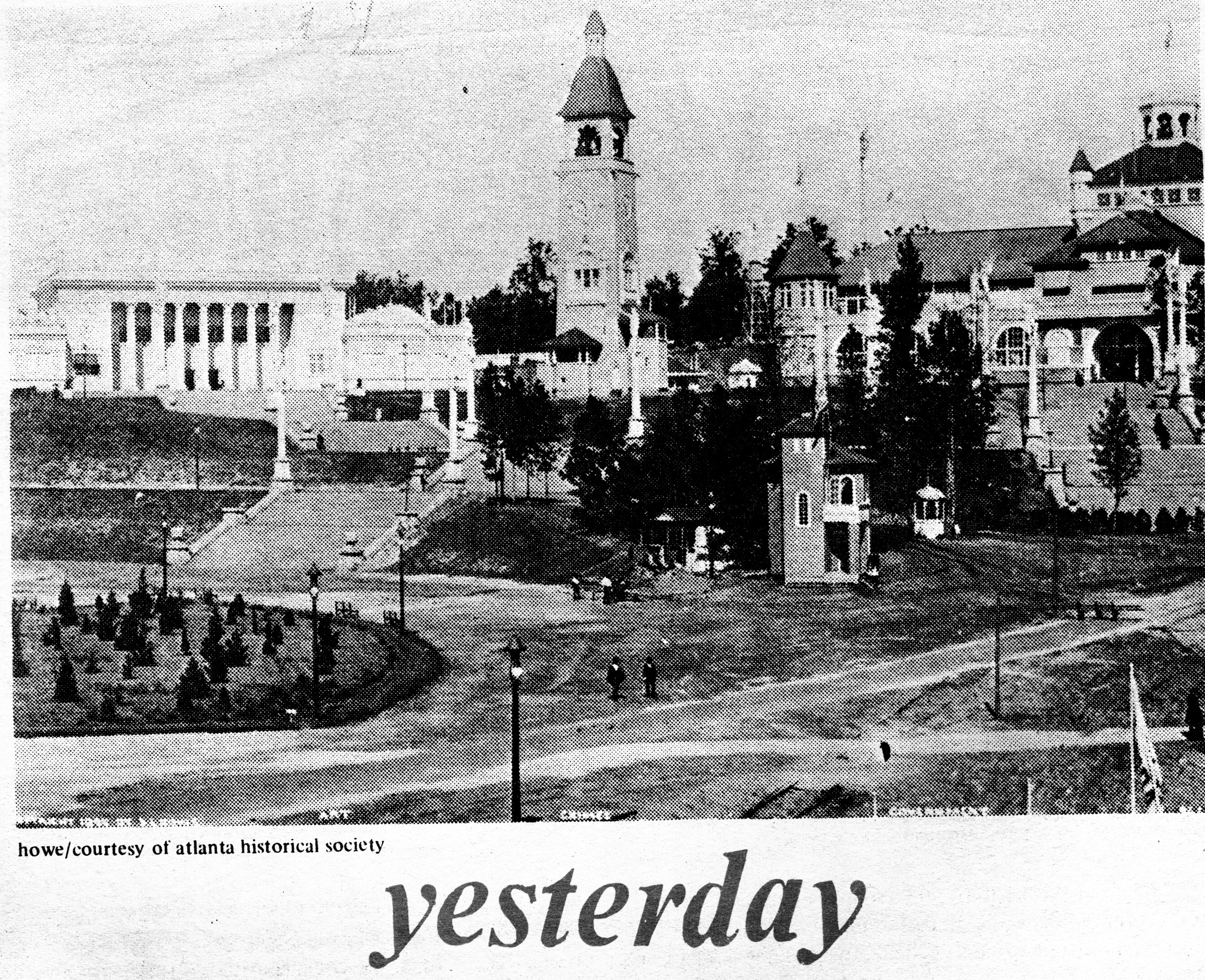
piedmontoldThe Piedmont Park of today began with the “Cotton States International Exposition of 1895.” The land, purchased from the Gentlemen’s (now Piedmont) Driving Club, was first used for a local event. “The Piedmont Exposition” in 1887 prepared the way for what became a world’s fair of its day.

The Exposition was a project of the South’s young white men-on-the-go who were working to industrialize the South in the North’s image. Many of today’s native white Atlantans look back nostalgically on the Exposition as an example of how Atlanta used to be able to get things done even in the most difficult times.

Atlanta and the South did overcome the effects construction with some bootstrap-tugging and a lot of help from Northern capitalists, particularly the railroad interests. The removal of the remaining Northern troops from the South in 1877 had sealed the fate of the newly “emancipated” blacks. The Exposition announces to the world that the South had made it. The Exposition was basically a trade fair ushering in heavy Northern capital like the textile industry, which for years would exploit Southern workers.

But not everything had been smoothed out by 1895. The Exposition needed financial support. To hold the Exposition it was essential that the U.S. Government make an investment. To convince a still northern Republican Congress to appropriate $200,000 for the Exposition and a Government Building, a committee of Blacks was formed and plans for a Negro Building were made. Congress was not hard to convince by that time and the money was appropriated..

So on opening day, in the auditorium at the top of the steps leading down to the Grand Plaza (now the athletic field), Booker T. Washington made his “Five Fingers” address, arguing that blacks and whites should remain socially as separate as the fingers on a hand, laying the basis for his later differences with a militant professor at Atlanta University, W.E.B. DuBois. The Exposition’s report describes how “a veritable era of good feeling between the white and black was ushered in by the Exposition.”It didn’t work out that way. Jim Crow laws were instituted throughout the South during this period, and Atlanta had “race riots” in the early 1900’s.

The Exposition was a grand affair. Gondolas and “electric launches” plied the waters of the lake. John Philip Sousa’s band played every day in the auditorium. The Liberty Bed was brought down from Philadelphia and placed on exhibit. In the Midway the first motion picture theater in this country did business as “living pictures” and Buffalo Bill’s Wild West Show performed in the southeast corner of the park.

The Exposition defined the park to come. The contours of today’s park were shaped by the chain gangs that labored for months preparing for Expo-95. The Grand Plaza became the athletic field, the foundation of the Manufactures Building became the tennis courts. Midway Heights and the Wild West area became the golf course, and the central terrace became the steps by the pavilion.

The City purchased the grounds in 1904 over the objections of some who argued that it was too far from town. By extending the city boundaries in the same year, the city fathers effectively silenced those opponents. During the years 1909-1910 the Exposition grounds were converted into the park, which today remains pretty much the same as it was then.

Now the Atlanta Parks Department has developed a master plan for the renovation of she park in keeping with its “Atlanta Parks and Recreation Plan-Projection 1983” recommendations.

The staff of the parks department has good intentions. Trouble is that Atlanta over the years has fallen far behind national park standards. Based on minimal standards, Atlanta has less than half the park acreage it needs. Over the past few years the Parks Department has been shaping up. A greenhouse complex was built in Piedmont Park, an arborist came on staff, the staff worked hard.

Then came Ivan Allen’s dream-The Atlanta Stadium. To obtain financing for the project the City agreed to guarantee the stadium bonds. The money to guarantee the bonds was taken from the Parks Improvement Fund. One half the fund-about $480,000 has been taken every year except fiscal 1969 and the chances are that it will continue to be lost to the Parks Department.

 Jack Delius. General Manager of Parks, has appealed to the Aldermanic Ordinance and Legislation Committee to request that the State Legislature increase Parks Improvement Fund, but so far nothing done. So the Parks department dues the best it can with limited resources to implement its vision of 1983.

So that means that the Piedmont Park Master Plan does not really fall in line with its 1983 projections. The report describes Piedmont Park as the only park in the city which “offers a large land area for unstructured leisure time use.” The report recognizes that one of the more common uses of a park is “simply the pleasure of getting away from traffic, buildings and others characteristics to enjoy strolling along wooded walks among trees and in fields or rowing a boat across a pond.” In fact the plan calls for the creation of four other large parks in the city to provide open space for “unstructured leisure time.”

But if the City’s Master Plan is put into effect as it stands, most of Piedmont Park’s usable “leisure time” space will be destroyed. The plan will create a central zone full of structures, parking lots, and program activities, areas bounded on the south by a pretty golf course, inaccessible to all but a few golfers, and a beautiful forest to the north, untouched by the plan but still used by a relatively few persons.

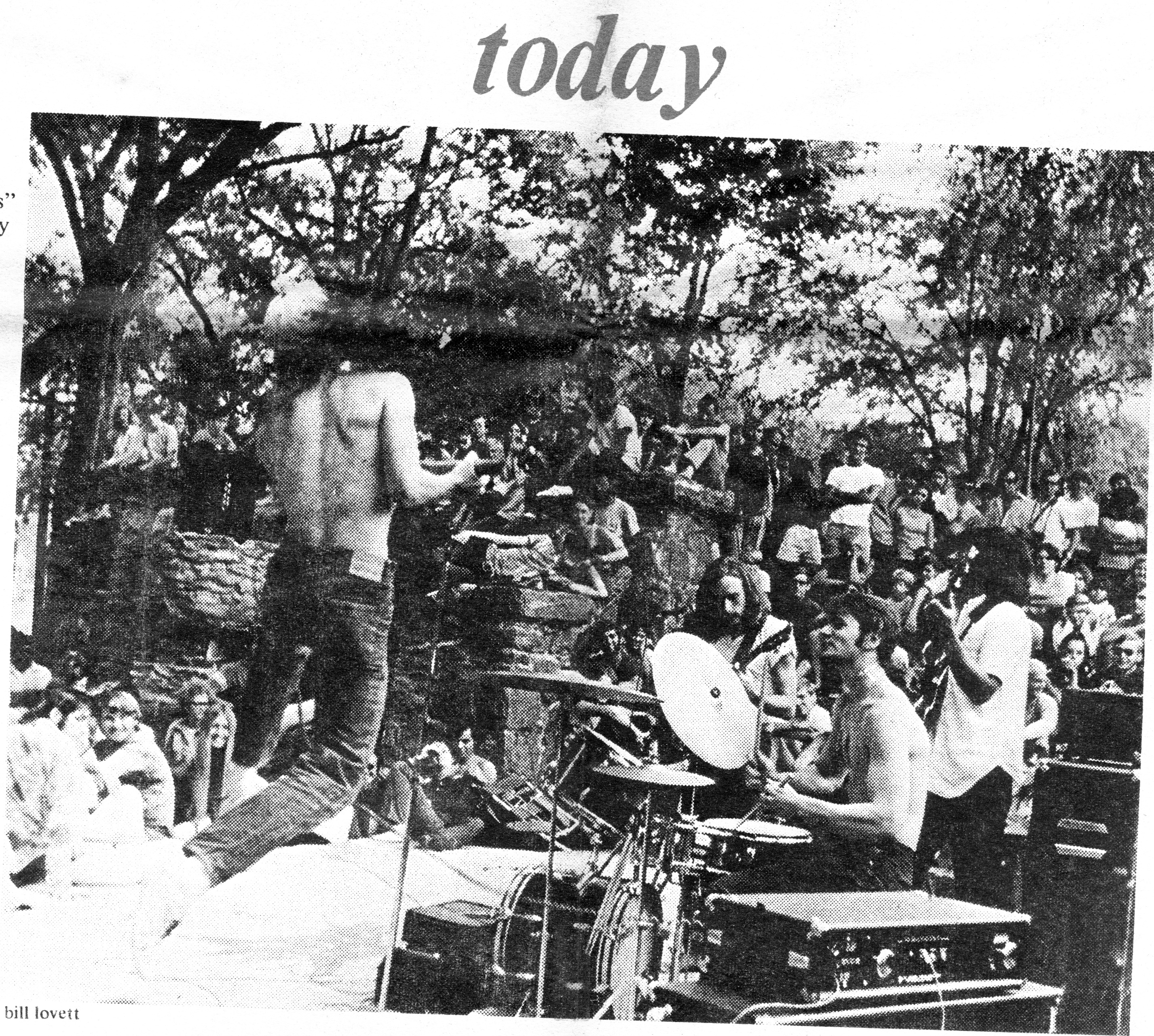
piedmonttoday Two of the main features of the plan should be implemented immediately. The Parks Department would like to close the park to cars and provide inexpensive bicycle rental to those who prefer wheels to foot. Boat rental is planned on the lakes, which are eventually to be connected with a bridge.

The problem is that the plan calls for lots of parking when the streets are closed. Land adjacent to the park is regarded as too expensive; another idea, to build underground parking under the tennis courts was rejected for the same reason. So parking is planned for the eastern and northern shores of the swimming lake, the area between the Legion Post and the 14th Street Gate, and the area around the greenhouses. That’s a hell of a lot of the park’s best “leisure time” space.

Is it wise to plan extensive parking in a central park along major traffic arteries in a city which must develop effective mass transportation? Is parking needed when office parking lots along nearby Peachtree Street stand empty over the weekends? What’s the sense of closing the park streets to cars if they are going to be sitting on parking lots inside the park?

The free and open athletic field will be lost in the plan. A new $387,000 softball tournament facility was to have been built this year in the southern end of the field. The city has an extensive softball program which serves many people. More lighted diamonds are needed. But tournament facilities are used for tournaments only one week out of the year and the complex will fence in over half of the athletic field. Perhaps the softball teams could get by with lights on all the diamonds and portable grandstands which would allow for other uses than just softball? Maybe the softball complex is one thing which could easily be located on other city property? In fact, the Atlanta Civic Design Commission, an advisory group, has come out against the complex, suggesting that it might be located at Lakewood Park. Apparently work on the complex (if it stays in the park) would probably not begin until next winter.

Also on the athletic field is to be a large swimming pool facility to replace the swimming lake. The Health Department says that the present facilities do not meet its requirements because there is no continuous filtration or automatic chlorination. The combination of the pool and softball facilities will mean little or no space for kite flying, informal sports, or music concerts.

To replace the present swimming facilities a waterside concert area is planned with a shell stage out over the water and seating for 1500—2000 where the present concession building stands. A smaller amphitheater is projected for the west end of the fishing lake near the 12th Street entrance.

 A restaurant and sidewalk cafe will be located along the north shore of the fishing lake. If they were reasonably priced that might not be too bad, except that very nice free space is destroyed. Then at the 14th Street entrance a gym and recreation center will be built. Both should be established in this community, both are needed-but perhaps not in the park.

The master plan is preliminary, subject to change. But three projects—softball complex, gym, and pool have been approved by the Aldermanic Parks Committee, although only funds for the softball complex have been allocated. No community or public hearings have been held on either the master plan or the three approved projects. According to Delius, hearings of some sort are planned this winter. The Bird will keep you informed of developments in the Park. When hearings are held we’ll let you know so you can attend. If they are not held we’ll let you know so you can raise hell. The park should not be lost to this community. It’s too important.

—gene guerrero

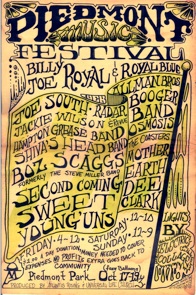
Universal Life Piedmont Park Music Festival

The Great Speckled Bird Vol 2, #  oct 27, 1969

thebirdback

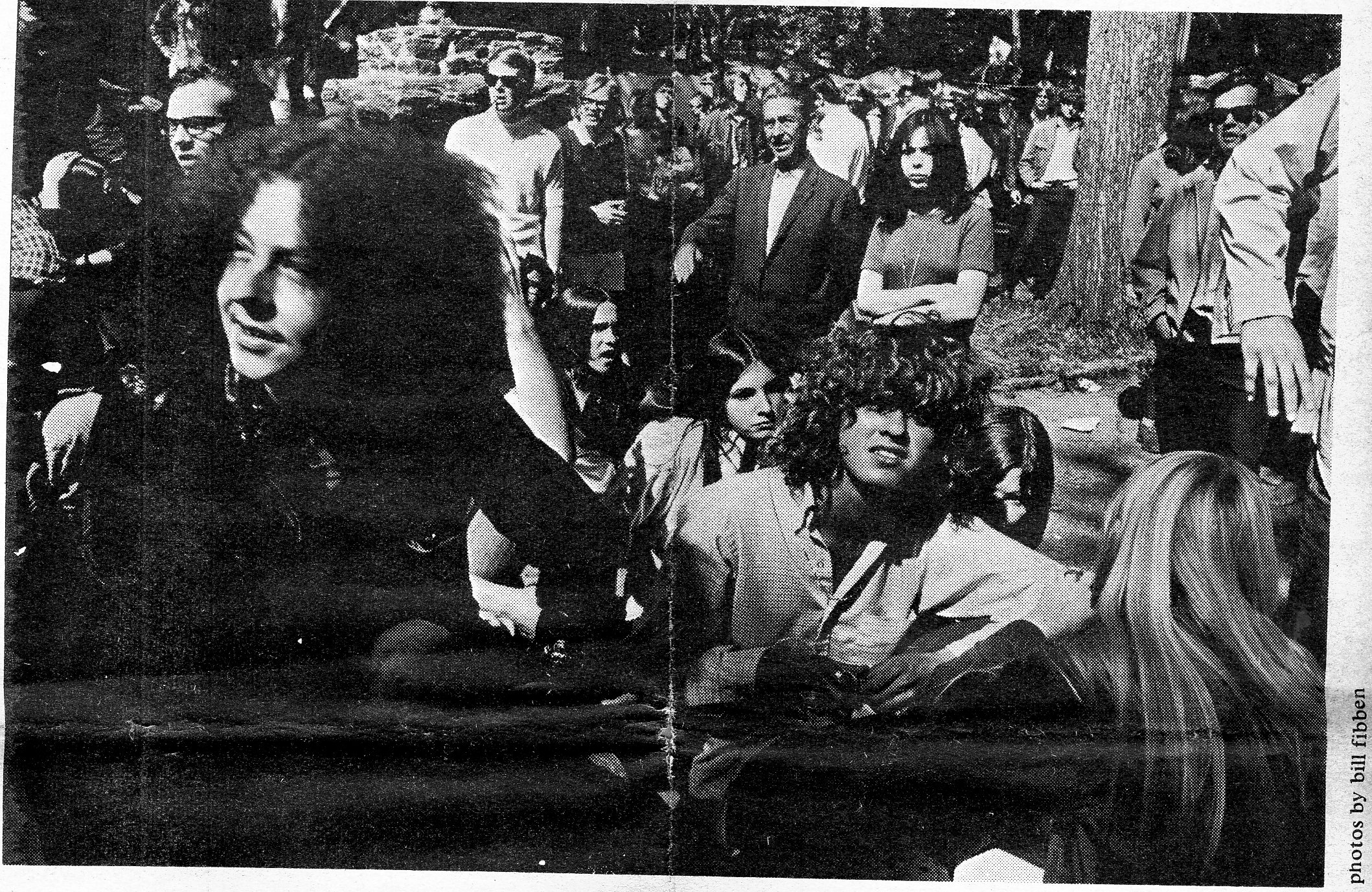
FRIDAY AFTERNOON was almost frightening all those big names, the abruptness of the pop festival’s appearance, the overall speculative nature of this ambitious musical venture and when we got over to the park, there was only a small crowd and some folk singer type running through a Dylan (new) imitation of “Lay Lady Lay.” The portable toilets on the ball field looked desolate in their isolation. Nothing looked good about the scene, and Frank Hughes of the Electric Collage light show was saying over and over, “Everybody’s wrecked!”

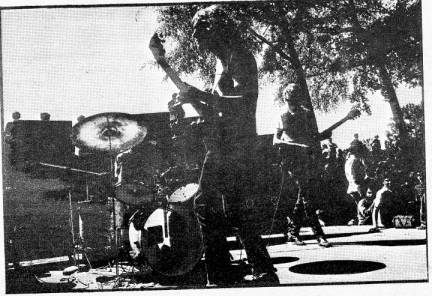
Then, miraculously, it happened. The Allman Brothers appeared on stage and began their set a familiar set of blues pieces, long, hard improvisations worked on a tight rhythmic foundation. “I’m Gonna Move To The Outskirts Of Town,” Donovan’s “There Is A Mountain,” one from their new album on Atco which might be called “I Feel Like I’m Dyin’,” some fantastic slide guitar from Duane Aliman on an excel lent arrangement of “Statesboro Blues,” and much more. One of the best exponents of where young pop music is at today, the Allman Brothers got the audience moving and initiated the festival atmosphere that had been absent up until that time.

The crowd was still small by sundown, but it was grooving and becoming larger all the time. We had just begun to realize that the night would be quite cold, but the idea of a pop festival in winter weather seemed oddly appealing (for once a tightly packed audience made some sense). The hippie/freak audience was there, a few straights, some familiar community winos, plus many, many new faces. One short fat fannie dug the music and the people; she thrust her dancing figure up front whenever possible and moved in and around the crowd with a beautiful smile on her face. A wonderful old wino with the face of a leprechaun put down his weather beaten suitcase and umbrella and asked her to dance with him, proceeding to demonstrate his own talents in a Wonderlandish dervish. Soon, everyone was in good spirits.

The band that followed included The Second Coming guitarist from Florida, plus the brilliant, beautiful bass work of John Ivey, and vocals and harp by Atlanta’s Wayne Lackidisi. The lead guitarist was into an erotic contortion bit (he turned in a better performance Sunday), and while Lackidisi’s screaming vocals sum up what is either the best or “the worst of white blues singing (depending on whether you like it or not), some of his harmonica contributions were exciting indeed.

The performance by Joe South in Piedmont Park should have been a major musical event; instead it was a fiasco. South appeared on stage with a trio of accompanists that looked like a Southern Velvet Underground (the suit South was wearing looked like silver velvet). There was an immediate reaction from the audience, one of suspiciousness and distaste from some, amusement from others. To say that a threat to the communal spirit did not exist for a moment would be a lie. South does not relate to the immediate experience of the Atlanta left/hip community in the same way that, for example, the Hampton Grease Band does, and the shiny, luxuriant exterior of the studio talent was perhaps too much in evidence, and with no conditioning for the audience. At the same time, Joe South is unquestionably one of the finest songwriters in all of pop music. We don’t think of him as a performer (though he is a brilliant one), but we are all familiar with his songs through the Top 40. Teenybopper purists who label his three minute pop songs “commercial” and relate to the twenty minute blues extravaganzas of the Allman Brothers as anything other than commercial simply create a false dichotomy between a business oriented around 45 rpm singles and a business built on the 33 1 /3 rpm album. Joe South and the Allman  Brothers are merely extensions of the same pop music experience, and they both make some fantastic music in their own areas.

Unfortunately, the sound system was fucked up throughout South’s entire set, and in the middle of one song, the power cut off altogether. South’s excellent vocal style was lost, some of the best lyrics ever to come out of modern country could hardly be heard, and what could have been some exciting guitar work by South was wasted on electronic distortion and noise. South was trying his best to get through “Hush,” “Redneck” (on the new Pacific Gas & Electric album), “Don’t You Wanna Go Home?” a hymn to the Atlanta community called “Gabriel,” and one of the best pop songs ever “Games People Play.” Aside from some attempts at humor that were often misdirected, a female vocalist whose raucous, out of tune shouting al most ruined what little music the South group managed to force through the faulty sound system, and a certain lack of acceptance from some in the crowd, it was good to hear this musical genius in our own park, and it is hoped that the event can happen again under better circumstances.

Considering the formidable musical achievements of Joe South, his last words “Thanks for putting up with us” seemed incredibly ironic. At this time in our development of a youth culture, we need all the bridges we can get, and Joe South may very well be the most important bridge between white country music and black blues and pop that we have. Certainly if one listens to his album Intercept, he will get one of the most all inclusive statements of the Southern hip youth experience available anywhere.

 Mother Earth followed South, and again the sound hassles seemed insurmountable. Tracy Nelson was there guzzling bourbon and turning what were probably exciting vocals on “Wait,” “You Win Again,” and a couple of others. She didn’t sing often enough for me in any of the sets in which Mother Earth performed. Boz Scaggs, an excellent guitarist but a largely uninspired vocalist, did some bluesy numbers and an “I Shall Be Released” that didn’t stir up anybody too much. The bassist was featured on a song that he wrote, and the pianist/ organist was the dominant voice on the closing number by Bobby Blue Bland. All in all not very heavy, but the things they did on Saturday with a functioning sound system were a more accurate demonstration of how good this band can be.

Frank Hughes’ Electric Collage light show, one of the finest anywhere, was in operation during the ill-fated Joe South performance, and even though the temperature went way down into the forties, people were grooving, and the loud applause that followed South’s exit from the stage showed that we were prepared to be patient and understanding while the hassles were being worked out.

Dope was everywhere. Various people made announcements (including some absurd compliments on our “peacefulness”), pleas for donations of $1, and at one point Robin Conant asked if we wanted a ballroom in Atlanta. Friday was filled with intimations that much more is going on at these musical events than can be confined within the boundaries

Of Piedmont Park. One hell of a lot of work was put into this park music festival; a lot of people deserve a lot of credit; and just as in the past, the community must support the developing music scene in Atlanta by its involvement. Whether we have a music of community, or end up as merely another link in a capitalist chain of “music” entrepreneurs is up to us.

-miller francisJr.

Saturday

Once more into the tentative temple of Atlanta Aquarians, to the ritual womb of the New Age, to get together, to let our music pour over and through us, hopefully like bonding cement same thing churches sometimes still pretend to be about to weld a communist whole, energized to sustain the struggle to smash the atomizing force working to pry us apart. To dig, that is, some music with the Family.

Crystal-blue day, throbbing (not baking) warmth, folks lolling around on the grass. Hand Band just finishing up (“Apologize for doing other people’s stuff, but it’s a fine tune.” Right on.) Comes now from Macon, GA, the Boogie Chillun, setting up their paste-on flower bedecked drums, testing their l-2s, then Thh-wanng! Into their opening/warm-up number like they knew what they were doing. They did. (Their bass man too far into it to perform “intelligently” he just let his fingers follow the rest of his body, which made the axe a supportive appendage of his total investment in his music. Fine.) Much excited appreciation of their vocalist’s copy of Led Zeppelin’s “I Can’t Quit You, Baby.” A copy is a copy, but Boogie Chillun‘s a young band, still putting it together, still, I felt, trying to “prove” something, still “performing” “for” an “audience,” instead of working with us to get off a tribal celebration. But. That’s how bands grow together.

Like Lee Moses. Four black bluesmen who both presented and built upon that genre. Lee Moses on lead guided all of us on a guided tour of the mysteries of the guitar, excitement modulator: advancing and retarding the frenzy building across the grass, until one incendiary riff jerked us to our feet, there to remain until the set concluded, we reluctant, but also relieved from concentration of energy that might have spilled us over our permit-bordered reservation (that’s a no-no). Nor was Lee Moses THE show never having seen the group before, we were several minutes into the set before I knew for sure who Lee Moses was one sign of a together group. Because the denimmed rhythm man toured his own force with a rendition of Tony Bennett’s classic (just-named-that-city’s-official-song) “I Left My Heart In San Francisco.” Not a song, though, not a performance, but an invitation to take a trip. (“If you wanna go, clap your hands, clap your hands now, clap!” We did.) Chanting the intro (Bennett never thwumped a crowd the way this guy did), and then rocketing into an improvised delivery of the (same old, but not really) lyrics, and we were there (that may have been what yanked us off our collective ass). Yeah, fine group-let’s hear’em s’more.

Then 1 split for dinner, despite Hampton Grease Band, who were, I understand, extreeeeeemely greezy, thwacking the skulls of the straight voyeurs with “Gimme an E G G S: EGGS!” (Whaduzitmean, whaduzitwmean?? Suck you ), and putting the Mobe leaflets distributed on the fringe of the park (dig?) to fine functional use the airplanes still filling the air long after I returned just in time to hear the Allman Brothers launch their own airplane.

Which circled for about forty-five minutes before coming down for a landing, hearing occasional reports from the control tower about topographical conditions (“First there is a mountain, then there is no mountain, then there is”), and cooking up a fine in-flight meal of intricate interplay, lead bass-rhythm organ, spiced occasionally with individual riffs. Hard number to top, but the rest of the set demonstrated what has been known and said well: the Allmans lay down fine, solid, gimmick-free sounds that do indeed work on you, if not as evocatively as Lee Moses (or the Hampton Grease Band), certainly as thoroughly Before Mother Earth the day’s last rap for funds (how to solve the dilemma: either admission charges or sugar daddies. The festival itself an attempt at synthesis: $1 donation, but when I dropped my buck into the box the attendant responded with “Far out,” like maybe not too many dollars were dropping the final balance sheet on the festival will be most instructive, and, I fear, sad) and a check to make sure most of us had got off (on?). ‘Feared we had.

Then an improvised Mother Earth, short I  understand, some personnel with Boz Scaggs added. Interesting-combination, creating a multi- focus group like Crosby et. al. or Blind Faith. Scaggs, and Toad Andrews traded off the lead, and the group changed coloration accordingly. As it also did, understandably, when Tracy Nelson, sang, the sound pouring from her mouth caked with clay, and oozing the richness of a stout young taproot. They were about the  transcendence of atomized clouds, the building of  power that occasionally thundered over us Saturday in sheets of undifferentiated energy. And when it all came down to borrow from the group’s title song), it was about the basics of life: love, sound health (“I Don’t Need No Doctor”), and making do.

The festival ended Saturday night at 10; permit ran out. But suppose it had not. Then why end at all?

(Concluding park-generated fantasy: how to make revolution. Suppose, I dreamed, enough groups got together to maintain continuous music beyond the saturation point. Two, three, four solid days. So that people could leave satiated, not fearing that they would miss anything/too tired to care. But leaving with the desire to keep it going, for what is more worthwhile, fulfilling, rewarding fuck it, FUN, than a festival? Not, of course, simply for the music, but for the communal consciousness: the shared joint, the freely given and received) food, the common caring for each other. And so people leave just to re- turn, but with sustenance for the festival. Bring back food, or dope, or bread for the generator. Take a job for two days, rap (automatically, unconsciously) on the job about the festival, come back, bringing three new freaks from work. Extrapolate extend the vision, so that ever more complex tasks are perceived and done to keep it going. So that the tribal existence is carried beyond the festival site; all life is viewed through the lens of the festival; all tasks are performed in order to get back to the festival, bringing something with you: food for ten folks, dope for 20, $40 for the electricity. Then it gets too big, so groups break off, start a new tribal campground, and it builds and grows organically, as revolution must in a country which is controlled in no one place, simplistic “Marxist” analysis to the contrary not withstanding. Until the old folks disappear bemusedly, and nobody wants to be PresidentGovernorSenator- MayorPig, and the whole world is a rock festival.

But.)

The permit did expire.

 -Greg Gregory

 Sunday

SUNDAY: after almost two entire days of a fucked up sound system, Sunday’s concert was a pleasure to listen to. The crowd, although sparse early in the day grew to several thousand by nightfall, and still exhibited its beautiful spirit of sharing, with much free grass and fruit circulating.

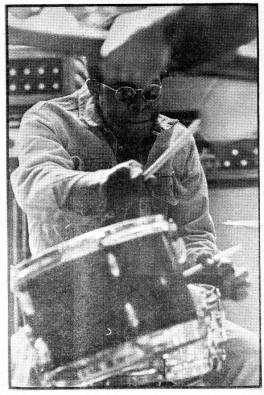
The old “star” system prevailed, and the local groups played during the afternoon. First to play was Radar, who sounded good for two reasons: one, the sound system was functioning properly, and two (more important), their material was enjoyable. After two days of almost all blues, good old rock and roll was a welcome relief. And they played it well, seeming to enjoy it as much as the crowd did. Only fault of this popular local group was a drum solo which seemed to be added on as an after-thought, especially because no other members of the group did soloes.

Following Radar came an unimpressive, but nice jam session, with the lead guitarist of The Second Coming, the bassist and drummer of the Allman Brothers, and organist and harmonica player of Mother Earth.

Next, the incredible Hampton Grease Band. Saturday they had destroyed the audience with their playing, and Sunday was no different. Playing a great version of “Wolverton Mountain” among their numbers, they again finished up only to have the audience bring them back for an encore with chants of “More, More!” After a set by an unknown Black group, came The Sweet Younguns. Unfortunately this group has been hung up playing too many high school and college dances, with the resulting Top 40 commercial sound demanded by these events. But Sunday night they proved that they have great potential, and given the proper environment to explore this potential, they could become a really first-class group. Their excellent singing and playing are already quite evident. Also they possessed some of the finest equipment seen and heard during the festival, and they used it effectively.

 Lee Moses returned to play again, after a really exciting performance Saturday. Their fine blues playing was one of the most popular acts of the weekend, and included an incredible version of “Love Is Blue” as well as “Hey, Joe” and some other more traditional blues numbers in the style of B. B. King. Real blues, and really singing the blues as well! And a real mind-blower for a finish a young boy about 10 or so came out on stage to play drums on Moses’ last number, and quite well, too!

Finally nighttime, but sadly no light show. Especially sad because Friday night’s show was the Electric Collage at their best. But the Allman Brothers made up for it. Little more can be said about them, other than the fact that only The Grateful Dead in Piedmont Park have generated the same energy that was created Sunday night. The whole experience was highlighted by a lovely girl dancing beautifully on stage.

And so ended Sunday night, but not before two couples were married on stage by a minister of the Universal Life Church, as a finishing touch to the Piedmont Park Music Festival.

-Charlie Cushing

Atlanta has had Radar for about two years now,

The Great Speckled Bird Dec 10, 1970 Vol. 3 #49 pg. 9

 Atlanta has had Radar for about two years now, and still isn’t aware of it. Besides the hunk Rock freaks who are subtly possessed and those insane followers from Radar’s roots in Sandy Springs, there exists few people whose spirits are lifted by the prospects of a Radar performance. This is an oddity, for Radar is one of the three Rock groups in Atlanta who have something to offer with their music. There are other groups with potential, but Hampton Grease, Booger, and Radar are the only ones who’ve matured to a point of originality and performance to rate acclaim.

I first heard Radar early on a warm Sunday in the Park during the season of 1969. Their material was fresh and away from the trends, but in the time passed they’ve unified the band and the music into a strong solid drive that excites and arouses. They’ve shown a growth in every performance, new material, new blends for old material, personalities, exploring each component of the Radar music for its maximum effect. They are four intense personalities who* have found that hard slot they best move together in, their energies providing a full cycle of lyrical motion and entertainment through one set. Characters

Jim Cobb is a product of music, dressed like he just pulled off his tie leaving church, bedroom slippers, and his notebook of song charts under his arm. Performing, Cobb’s bass draws motion from his open imagination, single-noting his runs through tight elative patterns that illustrate his knowledge and skill with the bass, innovative and progressive, yet he retains that purity and spirit of the early Rock that stormed our culture into its^ eventual recycle. Jim’s vocals are handled with a comparative fervor, loose with his casual yet forward manner, filled by that drive and whole with the Radar motion. Chris Cornish once seemed a rather plain and sober guitarist, but he is coming out as his musician’s confidence builds. His quality is not in being a “lead” guitarist, but a tasteful component of the whole. He listens and moves in where it’s needed, never overpowering the group sound with flashy up-front runs, an attitude used by George Harrison when he filled in the gaps for the Beatles. Meanwhile, Chris is nodding his body, making faces, and stretching into the mike to make his disciplined and capable voice perform for Radar. Singing the tales of noble reptilic monsters and senior class tragedies, his unique style and animated personality form the delivery and excitement.

Ottie Offen is all hunked up with motion. His skills, torn by a spectrum of influence, collect into successive flows through the progressions and burst into spiraling riffs in between, occasionally becoming a little too crowded during these peaks, but most often his piano is contributing to their entity. Ottie’s voice has a slight gravel vibrato and inflections that hint soul roots, violent, compassionate as he pours his dynamics into the swell of Radar.

Crazy Tony Garston addresses his drumming much the same erratic way he listens or talks. He’s constantly involved in finding new patterns and changes to give the music, never content with those tired patterns that makes Rock repetitious and horny. Tony pounces right out on top of you when you least anticipate his explosions. But Radar is rarely humble, and justly so, therefore it makes sense.

These four heroes concentrate to make the Radar music we fans all know and love. Even that “old war horse” of Cobb’s, the Mozle, is still stirring excitement, and more so than before for Radar |s always learning new tricks. Review

Radar’s climactic performance of the Mozle ’70 highlighted their last Gate: appearance, October 23. Their deranged following jammed the room to get their dues, and ever faithful Radar gave their all. The whole place was syncopated with that “motion” as Radar pumped out their music. Such favorites as “Jailhouse Rock”,’ “Louie, Louie”, and a “Whole Lotta Love” complete with destructive finale, shook the old house full that night. The clear feeling of their originals stimulated an aura of rushing excitement that peaked and calmed in complete cycles. 1 especially relish their performances of Chris’s “Swashbuckler,” Ottie’s “Georgia Moon,” the blend of Cobb’s “Heavenly Heartache” with Ottie’s “American Mag,” and Cobb’s two new songs introduced that weekend, “Long, Long Way” and “White Sun,” which illustrated his maturing as a writer and arranger.

The excitement eased and nearly subsided as piano-bar-style hip-medley-man Joel Osner played a terribly boring guest set, but was reinstated as Radar opened their final set with a one-act installment of “The Adventures of Lightning Lad,” a serial that is dedicated to good and evil simultaneously. The material, the antics, the between song patter, it cycles and Radar is always fun. Projection

Friday and Saturday evenings, December 4 & 5, the 12th Gate once again proudly presents Radar for your pleasure and elation. Ottie tells me that Radar has five new numbers to display and further “Adventures of Lightning Lad.” I expect Radar’s following to grow, in a town with so many people there should be absolute sell-out crowds to see a band this good, therefore it may be advisable to come early. It is well worth the effort and more than worth the lousy dollar admission.

—uncle tom

Well it was a good week for music

The Great Speckled Bird Jan. 25, 1971 Vol. 4 #4 pg. 10-11

Well it was a good week for music, at least. Maybe they’ve ail been good weeks for music, somewhere, ! don’t know. I’ve been staying home mostly with my pipe and Captain Beefheart, John Lennon, Derek and the Dominoes, the Jefferson Starship and like good company. Leave the street to the heat., oh yes.

But I got on the street and beat the heat to hear Little Feat down at the Twelfth Gate. And got a bonus. On the bill with Little Feat were the Stump Brothers, one of the Hampton Grease’s spin-off groups and always a smile to hear. The Stump Bros. are good musicians and generally play music which runs from solid rock to primitive jazz with a lot of echoes from the Fifties especially in the horn riffs. But this night (Tuesday) John Ivey had joined them on bass. I don’t know whether the addition is permanent or not but I hope it is, because Ivey’s playing took the whole group into another dimension of music. More than technical mastery of his instrument he possesses a musical conception of the bass that is way out front, in both roots and vision, of almost everybody around since Albert Stinson.

Little Feat were good, too. Solid “blues/rock/jazz/ folk stuff (categories!) in tight arrangements with Zappa overtones and showcasing a precise and biting lead guitar (lots of slide work), a very smooth and liquid bass (great night for bassmen), and especially near to my heart—some tasty old funky piano that looked to the traditions of Champion Jack Dupree and Little Brother Montgomery, et al, for inspiration. People are really taking to the piano these days, like Grace Slick and Bob Dylan for example. Anyway Little Feat were very together and made people feel good and, according to a well-rounded observer, generated even more electricity the next evening.

On the strength of such luck I went to check out the Bistro a couple of nights later where Jeff Espina and Ray Whitley were sharing the bill. Not having heard Espina since a magical night at the Barrel some time ago when Buddy Moss wandered in and joined him, and Whitley not at all,  I was curious as to what they might be doing, maybe even together. Okay well Ray Whitley and Jeff

Espina are both very good musicians and if you have never heard them you should go and do it. But I ended up disappointed in their performances for different ^ reasons. Although Espina is one of the powerful folk/bluest singers around lie did a set that 1 had already heard a number of times and I could not get turned on by it again. I even remembered the jokes. As for Whitley, he is a very warm and appealing performer, with strength underneath, but I must have caught a down set: I wanted to hear him do his own songs, a couple of which I had heard by other people and had really liked, but here he sang mainly John Lennon and Beatle songs and was not really into it either. Part of the blame for this might be laid to the audience which, although the Bistro itself is a nice enough place, has got to be one of the lamer audiences around. Whitley and Espina did not work together while I was there—1 left early— but they would probably be dynamite and I’d sure like to hear them do it sometime.

Saturday night was the giant hoopla concert at the Auditorium with Hampton Grease and the Allman Brothers, $3, $4, $5 a ticket, and completely sold out. The sound system was amazingly together at last thanks to great work by the Carlo Sound people from Nashville, and this apparently made a difference to the Grease Band. They turned in a fine set, introducing some new material in the tradition of their tight and complicated best, moving from rock into free jazz breaks a la Roland Kirk with flutes, sticks, and weird little noisemakers and putting down some electronic music on top, too. Strange how the shadow of Zappa peers out from the music of both Hampton and Little Feat in such different ways, but it does. The Greasers went on into a great parody of Detroit rock, did their old standby “Jim Evans,” and wound up with “Rock Around the Clock” and “Boney Maroney” just so we wouldn’t forget where they come from—rock , classicsville. Their record will soon be out on Columbia, and as an indication of just how good they are— which we who hear them so often tend to forget when the shock of surprise wears off-listen to WREK and the mix they have of “Jim Evans” from the forthcoming album. It relates to t schlock around it about like pearls to swine. If this record should happen to take off Hampton and company could find themselves turned into rock stars overnight. Oh yeah? Far out. What then? Well, speaking of stars….

 The Allman Brothers back in town! Great! Beautiful! Over the past couple of years their music has made some fantastic magic here in the park on Sundays, the different festivals, the concert with the Dead, etc., and we were all ready for more of the same in spite of the 3, 4, and 5 dollars—the band after all deserves some bread for their work and some thanks for those freebies.

Well the boys have made the big time now, that’s for sure. In two weeks they play Carnegie Hall. A more accurate sign of their new commercial success, however, here in America’s heartland would be all those rows of shining teeny-bopper faces gleaming out in adulation from the darkened hall, eyes fixed, riveted upon the sparkling stage and the spangled shirts, mouths slightly ajar. And by god they we re there. And then the Big Sound rolled out ….

The musicians worked their asses off. Leading off with the ancient “Statesboro Blues” in a somewhat defunked version, they moved quickly into album cuts, “Midnight Rider” and a very fine rendition of “In Memory of Elizabeth Reed.” They did a new tune, “Hot- lanta,” dedicated to the people of Atlanta, and they stretched out and tried hard. But somehow it just didn’t quite happen like the old days. No telling why. Maybe the star syndrome. If you’re a star you often tend not to take too many chances because you might blow one and fuck up your good thing; and without risks and reaching the tension drains out of your act. Duane Allman is certainly a super-guitarist, but this time his runs seemed all to have a certain sameness about them. Dicky Betts, the other lead guitar, appeared on the verge of really taking off once 01 twice. Where the Brothers came closest to really getting it on, though, was in a planned encore with their old favorite the “First There Is A Mountain” medley, and people were finally jumping and moving. But not like in the park or the Sports Arena, with the dying light and soft shadows and the common groove that folks have been working into all day high on each other and the trees and music and dope and freedom and room enough to run. So maybe again it was the whole set of a concert situation with fixed places and arbitrary distance between performers and audience that limited the show. But if it was not a mind-blower of a performance it was still quite mellow, and we look forward to Grease and the Allmans sharing a bill again soon. ; Incidentally, here’s a beautiful example for your primer book of the star system and the arbitrariness of concert promotion. Certain sources had it that the Allman Bros. were paid around $13,000 for their appearance, whereas the Grease band got $400. Isn’t that •weird’! Is there really $ 12,600 worth of difference between the two? Arid is it really necessary for someone (probably not even the musicians) to charge thirteen grand for a night’s work? Strange world. When asked for comment, International Ventures (the promoters) denied the thirteen figure but refused to say what it was they had paid, Phil Walden, Macon manager of the Allman band, also denied the thirteen grand figure and also refused to name the true sum, although he did mention that the band plans to do some more free concerts soon as they have a chance. Good news. But one has to wonder what all the secrecy is about- The Allman Brothers themselves were out of town and could not be reached. Ah, the romance of the music business and the sweet smell of…. BULLSHIT.

Later, craving some peace and quiet after the giant bash, I retreated to the Twelfth Gate again just in time to hear the tail end of Doc Watson‘s set there. Now this too was odd. For, lacking not only a huge group to back him up but also a massive p.a, system to put him across, armed only with a guitar or banjo and behind him a bassman, and sometimes not even any of those, this man was just sitting there generating more good vibes and magic and music than anything I had heard all week. Singing folk ballads and some slow country tunes and stuff like that. Not really what he sang, but the way he sang it. As if there were some sort of message hanging around it or something like that, not in the words but maybe in the feeling, or .. .. well, there was something he said.

 “If any of you people out there happen to own any big hippie clothing stores, I’d just like to remind you that you wear your clothes on the inside.” .

Could it be that this.,. .is closer?

This may not have been a great week for -MUSIC’, but it was a mighty damn good one.

-cliff enders

RADAR ! BUSTED

The Great Speckled Bird April 26, 1971 Vol. 4 #17 pg. 24

RADAR !  BUSTED

 Acting on a tip from their usual reliable sources, the GBI pulled a vehicle raid New Year’s Eve on several cars in Tifton, Georgia, suspected to be hauling distributional quantities of illegal narcotics. If their tip had any factual foundation to it, the culprits eluded the long arm of the law. However, the GBI was able to arrest Radar, along with some friends and Tifton acquaintances whom they had met at the gig they played that evening at Abraham Baldwin Agricultural College. The only contraband found was about a quarter ounce of marijuana and a little less than a gram of hashish: the straight press in Atlanta and Tifton also reported some amphetamines, but it seems that was merely a media invention. The GBI were hardly pleased with their find and were almost apologetic to Radar. One agent was reported to have said, “We’re after the trees, not the leaves.”

The ultimate results of all this was but one conviction and sentence. Jimmy Cobb, bass-vocal and leader of Radar, was sentenced to sixty days in Tifton County Jail. This of course, means that Radar will be out of action for this period of time, already having to cancel  their appearance with Spirit and Trapeze this past Sunday. It’s actually a good thing for the other two groups, for with a good wind Radar would have blown them off the stage.

—uncle tom

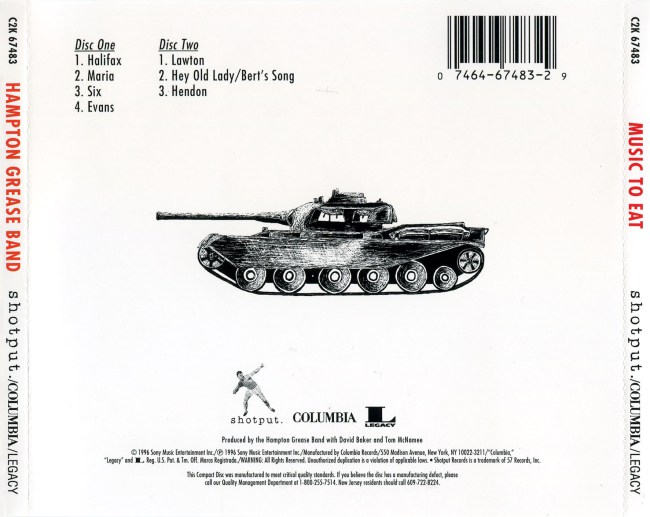
MUSIC TO EAT! FIVE YEARS IN THE MAKING! A CAST OF THOUSANDS!

The Great Speckled Bird May 3, 1971 Vol. 4 #18 pg. 5

MUSIC TO EAT! FIVE YEARS IN THE MAKING! A CAST OF THOUSANDS!

Music to Eat

musictoeat

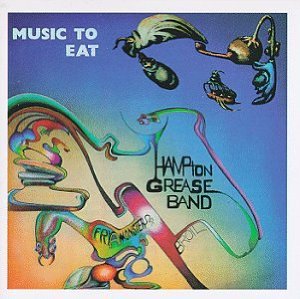
by the Hampton Grease Band  columbiaG30555

My first thought about the Hampton Grease Band’s new album is the same I had when the Allman Brothers’ record came out—it’s not the same music, of course, but the same feeling’, this is the band which has shared their music a thousand different times and a thousand different ways with our (their) community, and finally their efforts result in a chance for them to reach all the rest of those people out there, who I believe are gonna get their minds blown by music which I almost take for granted now—surely a kind of mild arrogance on my part, but more a natural pride and silent thanks as I witness Good Karma completing a cycle.

This album drastically deviates (does it ever!) from the write-some-quick-songs-go-into-the-studio-knock-out-an-album-in-two-days thing which is becoming a popular riff among groups. Anyone who has ever been at a Grease Band performance (and I use that word loosely) should know why. Probably the most critical part of the Grease experience is the chaotic interplay between the band and the audience (As Hampton once said, “They’re as much of what we’re playing about as we are …”; the resulting wide-open environment provides the chance for magnificent musical experimentation, and allows moments of weak music to go mostly unnoticed. Thus, for the Grease Band, submitting to the discipline of making tight, flawless music in the unnatural surroundings of a studio was a long, energy-draining process. For example, I was at the studio the night the band cut “Evans.”‘ For six hours they did re-take after re-take, Hampton being confined in a special soundbooth with only close.. friend Sam Whitesides for an audience. As the night progressed, the strain and tension of getting the full lyrical power of “Evans” to a final version was very evident. Now, six months later, I hear the result. I think they did it.

The album is a “family” (ad)venture much in the form of the Grateful Dead’s music: the band provides a core for group of people whose personalities (?) and relationships with the band strongly influence the music look at the song titles “Evans,” “Hendon” “Burt’s Song”,  “Lawton. ‘) And the Grease Band and their family, from what I know and have heard, can usually be found playing on that thin edge where Genius and Insanity come together. Sid (of the family) once told me that they are all simply children who never grew up—1 think I am beginning to understand …

hampton-grease-bandAs a final thought, I’d like to reprint the answer the band gave in an old Bird interview to “What kind of music do you play?”: “Suckrock. It’s a combination between suckrock and ointment. See there are a couple of people in the world who are playing Grease -The Mothers, Igor Stravinsky, Bill Haley and the Comets. They all got their own kind of Grease. Otis Rush Blues Band, Albert King, B.B. King, Buddy Guy, John Coltrane, Archie Shepp. It’s not a musical form, it’s a musical concept. It can include any category. It covers country, it covers everything you do. Grease is a form of life; it’s also a form of eggs; it all leads back to eggs.” And eggs are to eat. So is their music.

—moe1971-music-to-eat-box-back

Cultural stomp

The Great Speckled Bird Sept 8,1969 vol. 2 #26 pg. 15

Cultural stomp

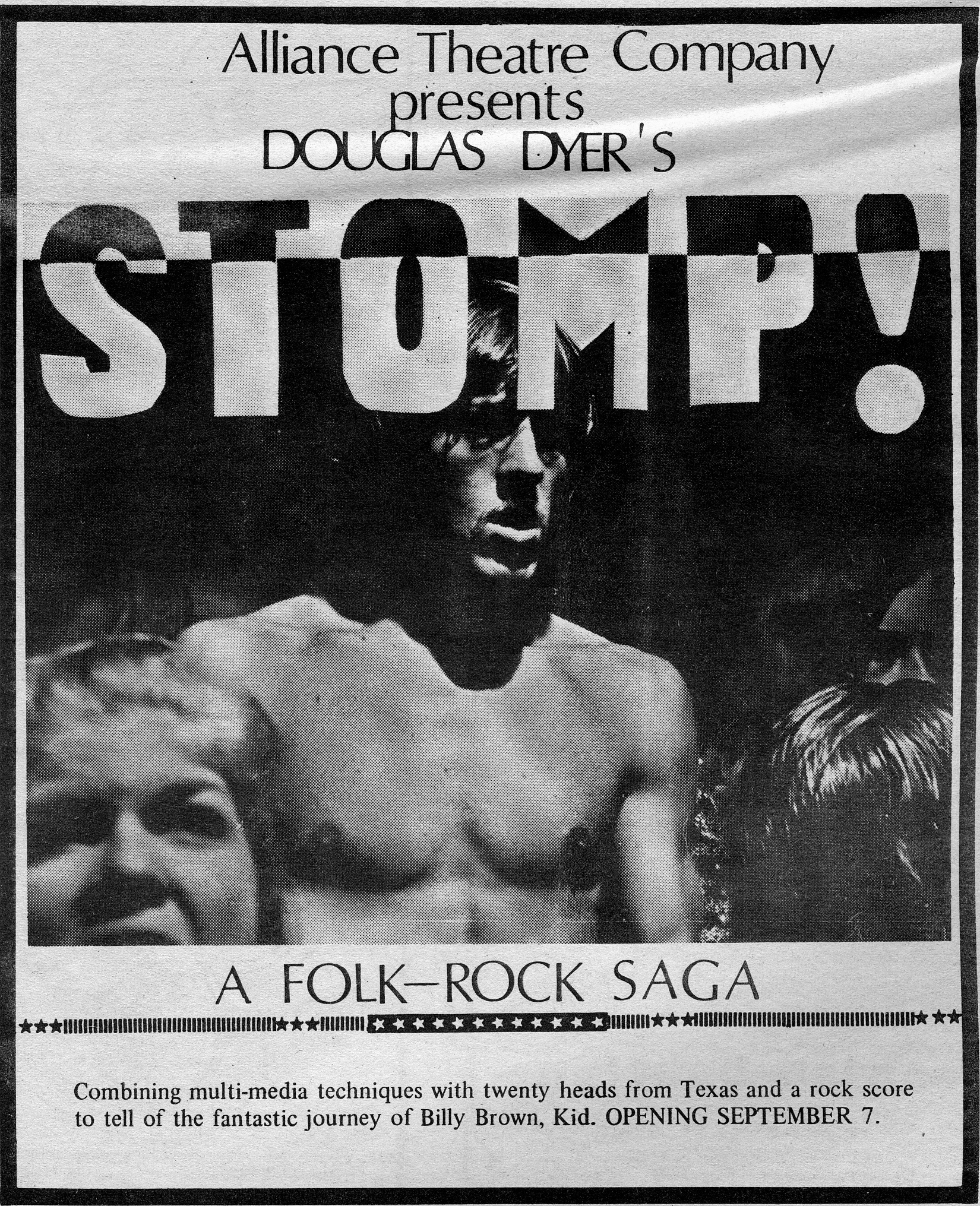
stompAtlanta theater has been dying a painful death for the past several years. And Atlanta audiences have been suffering from cultural deprivation. But Michael Howard, director of the Alliance Theater is taking a step to improve the situation.

On September 6, a group of young people from Austin, Texas, is giving Atlanta an opportunity to witness what may be part of the rebirth of theater.

Mixed media-a live rock band, film, song, audience-actor participation—is combined with the story of a kind of Everykid in the new and exciting way of communicating what these young people are trying to say.stomp

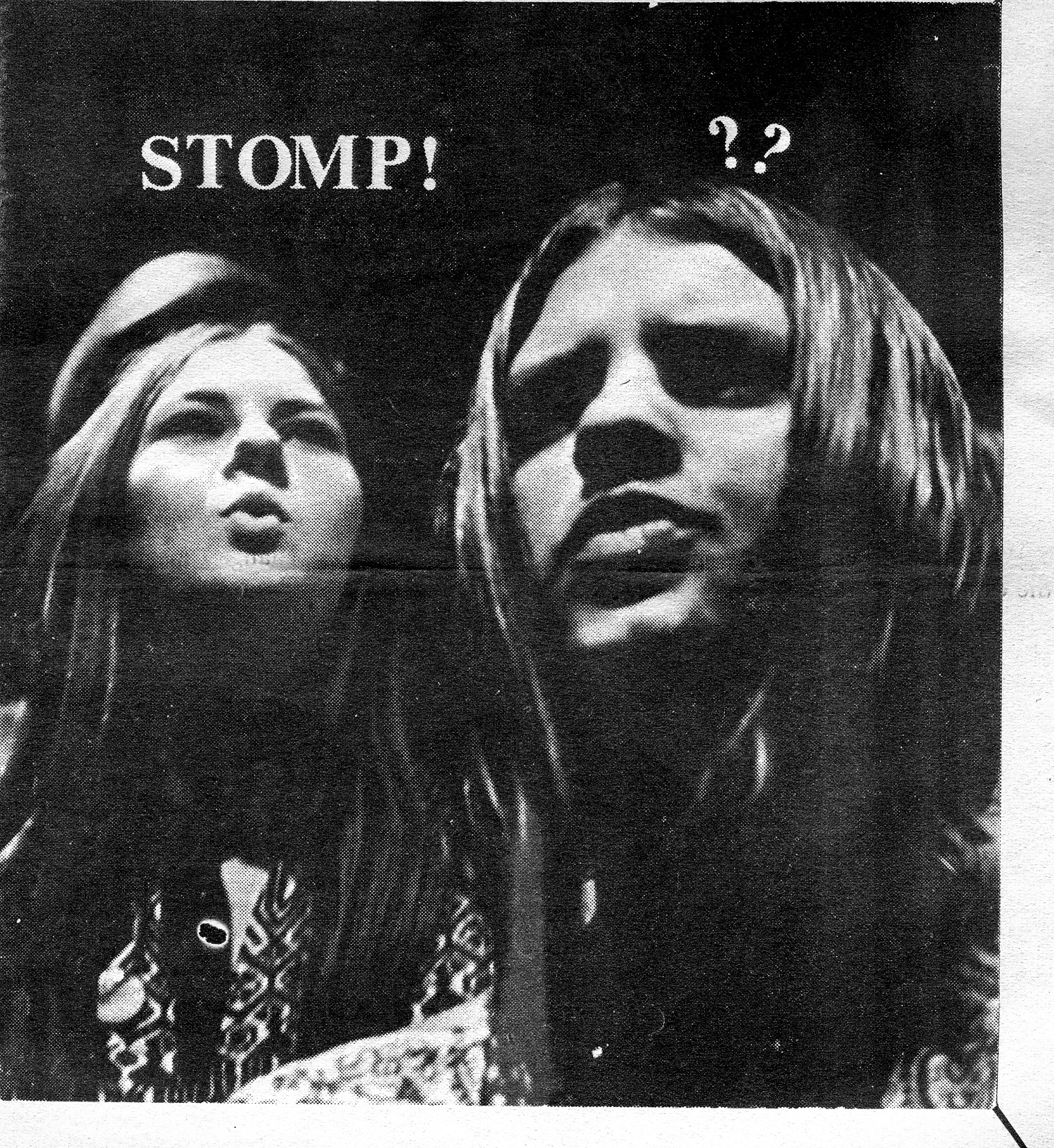
“Stomp” is an experiment in communal Theater. Under the direction of Douglas Dyer, the “Stomp” cast has been living and working together since the play was first created. Although it uses a tightly structured plotline, it is also an experiment in breaking down the antiquated isolationism of the audience and drawing the audience into participation. It is an experiment in speaking with eyes, hands, minds—not just stage voices. It is an experiment in which Atlanta audiences must participate in order to understand.

If this new, relevant, real theater is to survive, people must open their minds and support it by involving themselves in the experiment and remembering it.

Opening Saturday, September 6, at 8:30 p.m. Be there and be open.

—Pam gwin

Bucky Wetherell was with STOMP.  Listen to his interview.

stompad

STOMP!, written and directed by Douglas Dyer, in the crypt of the Mausoleum for the Arts.

Nothing is so flaccid as an idea whose time has come and gone. The idea for Hair was timely conceived, executed, and fully realized. Stomp! is an almost-frank attempt to exploit the concept of Hair, to resonate to its sounds, and to reproduce the responses to it. Stomp! is too tiny in conception and too weak in execution: it is almost a tiptoe.

The performers are young, from the University of Texas, where the show started as a campus production. They try hard and are almost enthusiastic most of the time. I, too, tried hard. I really worked to believe. In the end 1 could not believe; the show said nothing to me. 1 kept the beat of the music even when (most of the time) I could not hear the words. The words I heard eddied around in an intellectual circle, in the service of no central conception.

The message of the show is purportedly revolution, but it is an all-purpose revolution, one uniting or deceiving everyone and no-one: the clichés of brotherhood, war-resistance, sexual liberation, and left liberalism. In the end you stand on the lawn outside, the Experience past and quite meaningless to you.

Some of the media things come off; some of the people are obviously very good people; some of the ideas were very good ideas and now entitled to a dignified old age. These do not make a play. Go. It only costs $3. Try very hard, and see how hard you can work, without direction, to accomplish nothing.

– Morris brown

stompheldThe Bird wails: “Atlanta theater has been dying a  painful death for the past several years.” But hail the new hero: Michael Howard comes. Stomp in hand. offering a mixed-media novelty.

But that is all wrong. Theater has been dying/not in Atlanta but in the West, the same painful death that all culture must undergo before revolutionary rejuvenation or eternal mummification. The best of it, the Living Theatre, Che, are merely crumbs from the grand repast of the future at best or a safety-valve offering moments of escape from an eternity of perversity.

Nor did the theater ever die in Atlanta: it was never alive here to begin with! Not, at least, in the grand sense, but only in the form of a few experimental fragments most notably at the Academy Theater and, lest we forget, Arthur Burghardt’s efforts in Dutchman. True, Atlanta has built an imposing mausoleum for a never-was theater as part of the High Museum, ranking just below Rich’s as an architectural wonder. Stomp, then, may he fine despite the company it keeps. But the real theater cannot be reborn where it never lived, certainly not in the High Museum. Theater must be now where the people are: there, out there, at work, at play, at war, at death, at hunger. In the streets: guerilla to date, not too successful here, despite tremendous success elsewhere, but that’s where it’s at or got to be at. Not the Atlanta Pop Festival, but the aftermath in Piedmont Park was the real. Not what the people from Austin can do on the stage, but what we all do here: that’s real. Possible scenarios: Riot on Fourteenth Street, Layout on Bird Night, Park Scene on Sunday, County Jail, etc. In fact, they’re all being staged, again and again, nor is there any danger of a future takeover alienating the spontaneous culture from the community by the activities of culture sharks a la [Steve] Cole. It’s ours, because we live it.

Ted Brodek

Stomp Vamped!

The Great Speckled Bird May 3, 1971 Vol. 4 #18 pg. 5

Stomp Vamped! 

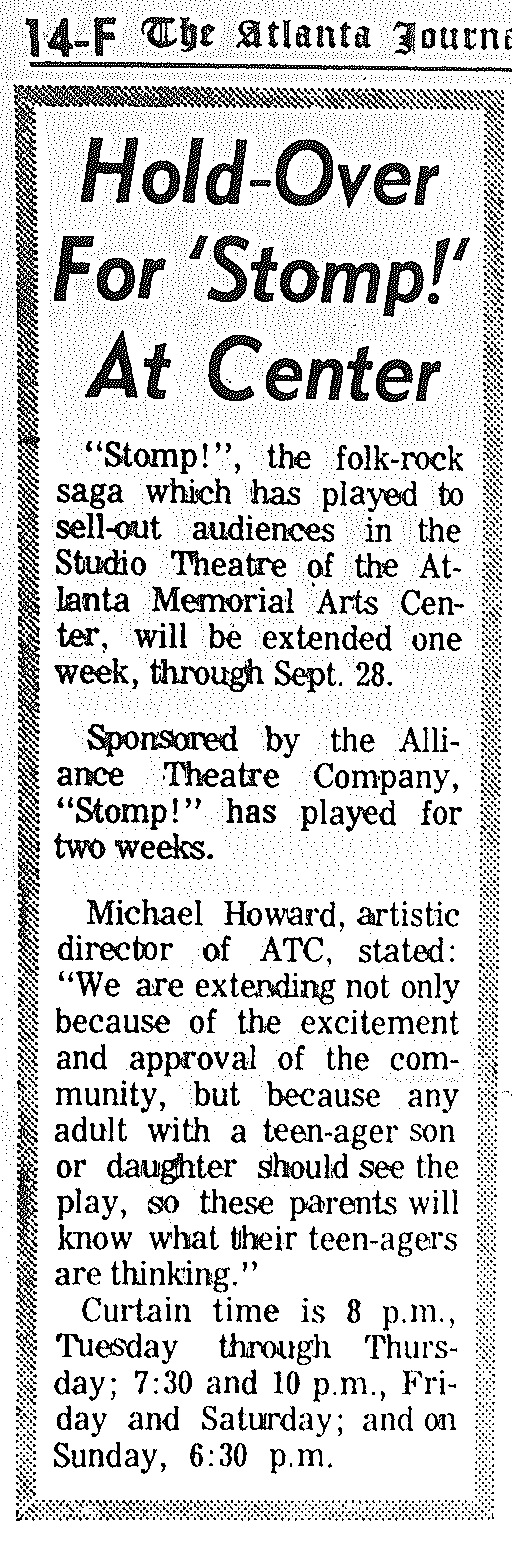
stompburnIt appears that artists in Atlanta will have to look to the State for approval of their creations or else subject their work to later censorship.

Stomp, a rock musical with social and political content, has been threatened with mass and repeated prosecutions if certain scenes were not taken out of the production.

The people involved in Stomp, known as The Combine, decided to perform two nude scenes in the show with clothes on until they could, along with  their ACLU attorney, Morris Brown, decide on an action to take against the Georgia law being used to censor their production.

Jack C. McEntire, Captain of the Atlanta Police Department and William Baer Endictor, Esq., Assistant Solicitor General of the Criminal Court of Fulton County, told Alex Cooley, producer of Stomp, that if an objectionable scene was restored to the show, the Atlanta police would arrest everyone connected with the show, including “the man who cuts the grass,” and all would be prosecuted.

One of the nude scenes in the unadulterated show is “the birth” in which a woman is naked from the waste up. The other scene is “the river.” An actor described the scene as being involved with nature as closely and purely as possible which requires removing clothes. Neither scene is obscene or lewd.

The law threatening Stomp is S26-2105, enacted July 1. It states:

(a) Every person who, during the course of a play, night club act, motion picture, television production or other exhibition, or mechanical reproduction of ^human conduct, engages in conduct which would be public indecency under Code section 26-2011 if performed in a public place, shall be guilty of participation in indecent exposure and upon conviction, shall be punished as for a misdemeanor.

b) Every person who procures, counsels or assists any person to engage in such conduct or who knowingly exhibits or procures, counsels or assists in the exhibition of a motion picture, television production or other mechanical reproduction containing such conduct shall be guilty of a misdemeanor. ” (thus the grass cutter)

The vagueness of this law threatens everyone’s participation in the creation and exhibition of art.

The Combine, believing this law to be unconstitutional and one in a series of political harassments, has begun a class action to enjoin local law enforcement officials from enforcing this law until its constitutionality can be tested. The plaintiffs are: Alex Cooley, producer, Elizabeth Herring, Ronnie MacKey, representing the Combine, and M.E.Johnson, Jr., a private citizen who feels his rights are being denied by the censoring of the play. No hearing date has been set.

Although The Combine performed the nude scenes clothed on Friday night, they had decided to do the scenes naked on Tuesday night. The Combine could be protected temporarily from arrest if they performed the nude scenes by a restraining order or temporary injunction. If they failed to get a permanent injunction, The Combine could be busted on past shows performed with the nude scenes.

The Combine started out in Feb., 1969 at the University of Texas in Austin. They traveled with the show (then Now The Revolution) to Houston, Atlanta, New York and 16 performances in Europe, including the Dubrovnik Festival in Yugoslavia and the Edinburgh Festival in England. The show was televised in Scotland, Amsterdam, and taped in Munich for European distribution. All this without political or social hassle.

After returning to the U.S., the Combine chose to return to the south and play in Atlanta.

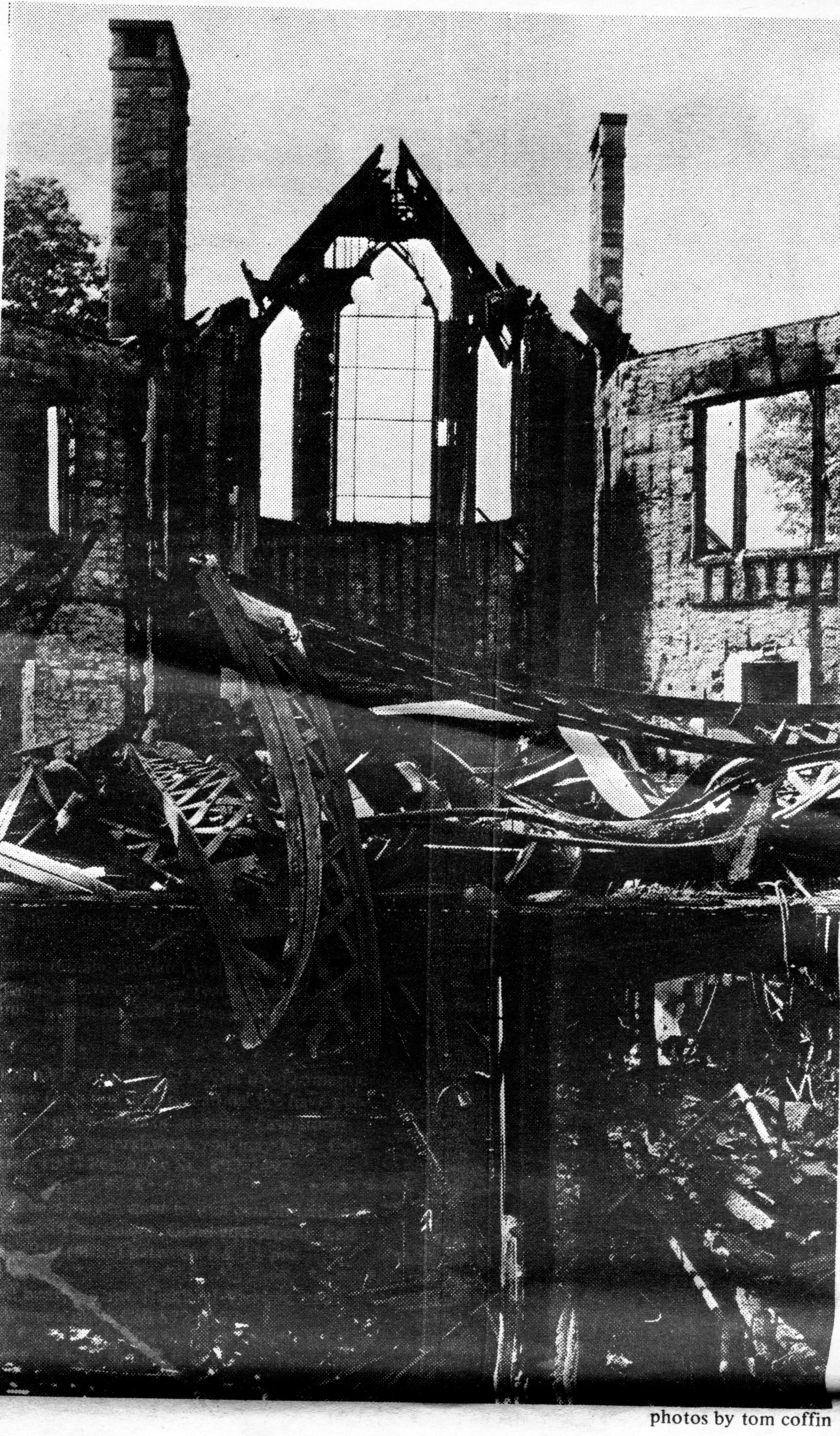
On Friday night the main concern of the Combine ‘ was whether or not to do the nude scenes. On Sunday, everything was changed. At 4:57 am, a fire alarm was called in for 3156 Peachtree Rd.—the site of Stomp’s theatre. In about an hour, the building was destroyed. Lieutenant Lester who handled the fire said: it “burned so completely that I can’t tell (how the fire started)—we don’t even know if the fire was lit.” –

Alex Cooley, however, believes that the fire was set. He said that the building was wired by electrical contractors, inspected by the city and approved by a master electrician. He added that the electricity was turned off each night at a master switch; there was no gas in the building. In fact, there was no utility going into the building except water.

He said that the last person left the building at 10:45 pm and it was unlikely that the fire started by spontaneous combustion.

On Monday afternoon, the gutted church was being torn down because it was a “dangerous construction,” Lester said. “It may help us really, when the building gets torn down. . .we will look into it as it’s being torn down.”

Since coming to Atlanta, the Combine has been hassled with dog complaints, health complaints, nudity complaints, the threat of losing children, and have now lost their stage!

All was destroyed in the fire—props, music and instruments, and lighting. And the Combine had no insurance. But they are looking for a place to perform again and will improvise whatever they have to; Then they will take up the fight with the state again.

—Lucia droby

Allman Brothers meet Atlanta!


A Personal story of May 11, 1969.

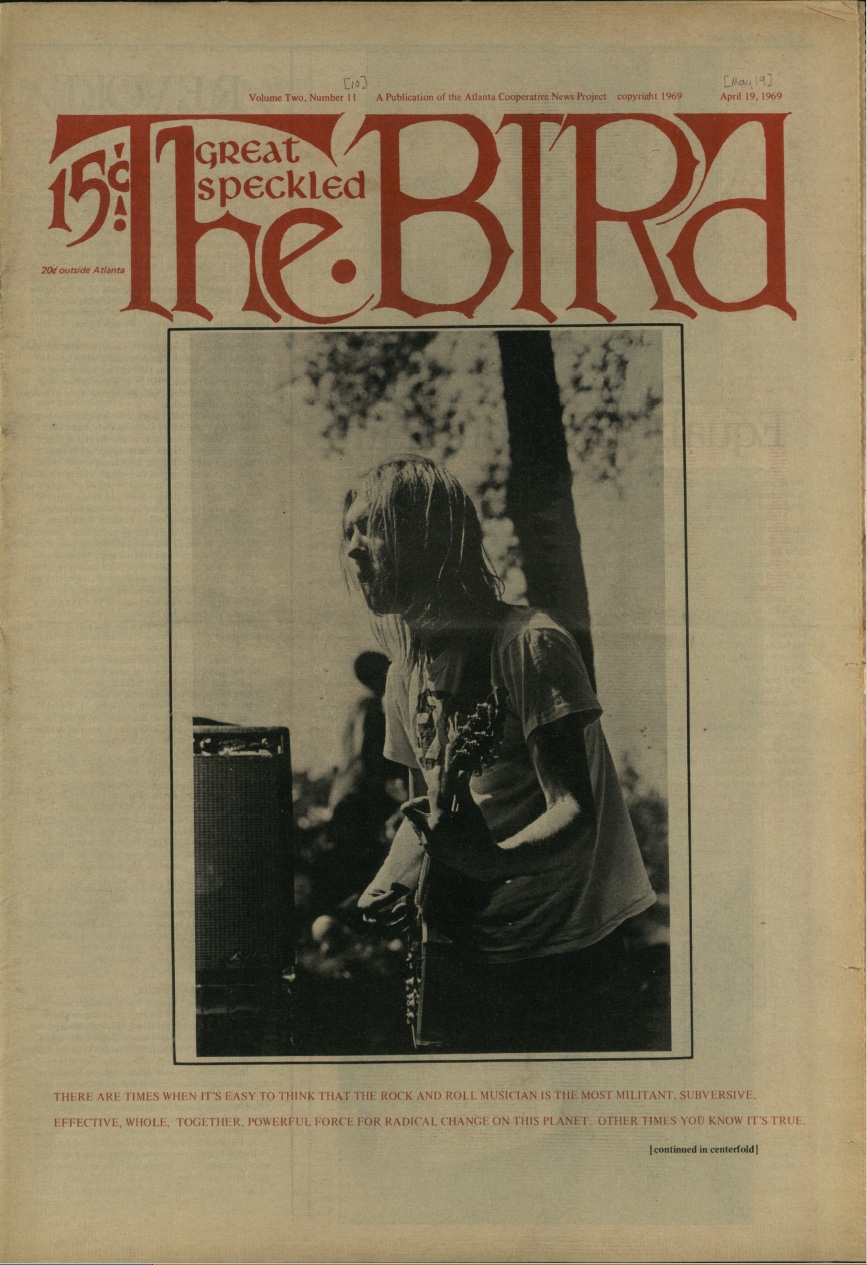
Upon first seeing the Allman Brothers Band, an interracial rock and roll band from the heart of segregated, reactionary Georgia not only calling themselves brothers, but acting like it, Miller Francis of The Great Speckled Bird put Duane on the cover with the words: “There are times when it’s easy to think that the rock and roll musician is the most militant, subversive, effective, whole, together, powerful force for radical change on this planet; other times you know it’s true. “

Georgia State University’s Library has this issue of the Bird available as a pdf. here.

The Great Speckled Bird

Vol 2 # 11 April 19, 1969

by Miller Francis

duane

The Allman Brothers play a form of what some might want to call “hard blues” but that term merely relates their music to what we already recognize and accept as valid; it says nothing of their real achievements. What informs their creation is not black music but the experience of young white tribesmen in experiencing black music. After all. Ray Charles, and what he means, is a crucial part of the lives of this new generation of non-blacks. Thus black music can be approached creatively by our musicians if the jumping off place is our experience of that music rather than the music itself.


EPSON scanner imageQuote of the Week:

Policeman, after complimenting Barry for getting together such a pleasant, orderly crowd, “You can stay in the park all night for all we care.”

A leaflet drawn up by our “leader” says “Last week we were attacked. Some of us were shot. We were jailed, the culprits have not been caught The police did not and have never protected us” yet the same self-appointed “leader” personally takes it upon himself to represent the community by asking “permission” from the same power structure which exploits us, permission to listen to music which belongs to us, permission to meet together in a park which also belongs to us! The Man can’t bust our music. -don’t count on it.

Definition of MUSIC AS POWER. A perfectly straight middle-aged man stood near the band in the park Sunday, mesmerized for two hours at sounds which took him places he never knew existed. After the band took a break, his remark, more than a little unconvincing even to him as he said it, was, “That’s just a lot of noise. ” He knows things he doesn’t know he knows, and the character of our generation is determined by just those things.

 EPSON scanner imageRock & Roll, our New Music, is sound for the head and body, orchestrated, electric, cosmic music that will rip you up by your corporate America roots and set you down just inside the Gates of Eden outside of which, we’ve known for some time now, there are no truths. You don’t, can’t, “listen” to the Allman Brothers; you feel it, hear it, move with it, absorb it, you “let it out and let it in” (the Beatles) and enter into an experience through which you are changed. You catch a glimpse of the kind of world we are becoming and you know more than ever the horrendous load of bullshit we’ll have to drop off on the way in order to give birth to that kind of world.

 A rampant fear of the mythical dragon of “Communism” (a la J. Edgar), nourished and fed by the power structure, flows throughout the hip community of Atlanta like a poison fragmenting us, blocking any efforts at organization, and our self-appointed “leader” holds up an SDS button, and says, “I transcend this.”

EPSON scanner imageTHE ALLMAN BROTHERS

Duane Allman-Guitar & Vocal

Gregg Allman-Lead Vocal & Organ

Berry Oakley-Bassist

Butch Trucks-Drums

Dickey Betts-Guitar

Jai Johnny Johnson-Drums

 Class prejudice the whole “redneck” concept—destroys the community from within, rendering it impotent, and our “leader” organizes us around contempt for the working man.EPSON scanner image

The Colony 400 monster rises in our very midst, attempting to determine how we will live our lives, and our self-appointed “leader” tell us hat “fear” and “paranoia” are our only enemies.


The Allman Brothers from Macon, Georgia, are a fantastically together group of young rock and roll musicians whose music draws as heavily from the blues: as the experience of young white tribesmen can without exploiting its source—a few steps farther and you get a merely talented farce like Johnny Winter. Since our generation is tribal, totally unlike our parents and grandparents and their parents, it is only natural that we would turn to the black man, whose tribal roots go so much deeper and do not have thousands of years of bullshit “civilization” to cut them off from these roots, for forms with which to relate to the new world. image020The history of the black man in America is the history of tribal man in an alienated, fragmented, capitalistic, literate, industrial, “I”-oriented culture; young people are simply showing good sense when they attempt to co-opt black culture (just as the dying order desperately attempts to put its stamp on the culture of its youth)—but creating and redefining our own culture in terms of the new space-age tribalism is the crucial struggle and follows as naturally from where we are at now as Grace Slick follows Patti Page. The blues, the entire complex of music which has come out of the experience of the black man in America, belongs to forms and patterns and relationships to experience of which we now have only the tiniest fraction of an inkling (even that is a hell of a lot). The black man’s blues (whether manifested in Lightnin’ Hopkins or Smokey Robinson and the Miracles) flows out of him while our “blues” is wrenched out bloody like a prematurely pulled tooth. image022Contrast the shouting subtleties and the rock- like soul of a Mahalia Jackson with the strained histrionics of a Janis Joplin (who, somewhere down under her package, probably does have some soul of her own). Art is not a product, it is a process: the blues—whether country or urban, acoustic or electric, raw or commercial -cannot be copied from records or concerts or books on black culture. The musical language of the black man cannot be co-opted simply because it happens to be powerful and sings of things we are just now recognizing as more valid than what we have been hung up in for centuries. Our music must develop its own power, its own forms, its own patterns of relationship with our tribal roots and our space-age technology in an unbroken line all the way down into our preliterate origins and all the way out into unknown galaxies.EPSON scanner image

The Allman Brothers know all this, and a lot more.


What we find in Piedmont Park on Sundays is a celebration of the awareness of the tribal experience. It in no way resembles the mass media bullshit image of the Haight-Ashbury community of “hippies” living like stoned zombie children off the sweat of others; it is an integrated collectivity of many different kinds of people intermeshed in an unbroken psychic web that transcends class, color, age and sex, and makes all of these things meaningful only within the context of the struggle to crush the power structure that stifles all of us.

 image014The “political” manifestation of the Sunday Piedmont Park experience undid everything the music had built up. The sounds produced a together, militant, upright, powerful group of people involved in a psychic community struggling to become physical, to become “political” in the largest sense of the term. The politics of the “open” microphone is the equivalent of a band in which only a “lead” guitarist is amplified-it belongs to the past along with “teachers” and “employers” and “managers” and “leaders.” If we must have raps with our music, let them be unamplified groups planning whatever action they deem necessary. If hundreds of tribalists get sufficiently turned on, each one on be his own open microphone.

image016

 The Merry-Go-Round exudes an odor of capitalist shit that you can smell all the way down in the park, and we are told by our self-appointed “leader” that our enemy is “violence.”image018

Capitalism the logical extension of the word “I” exploits the life style of our movement and our current self-appointed “leader” attempts to organize his own ego trip.

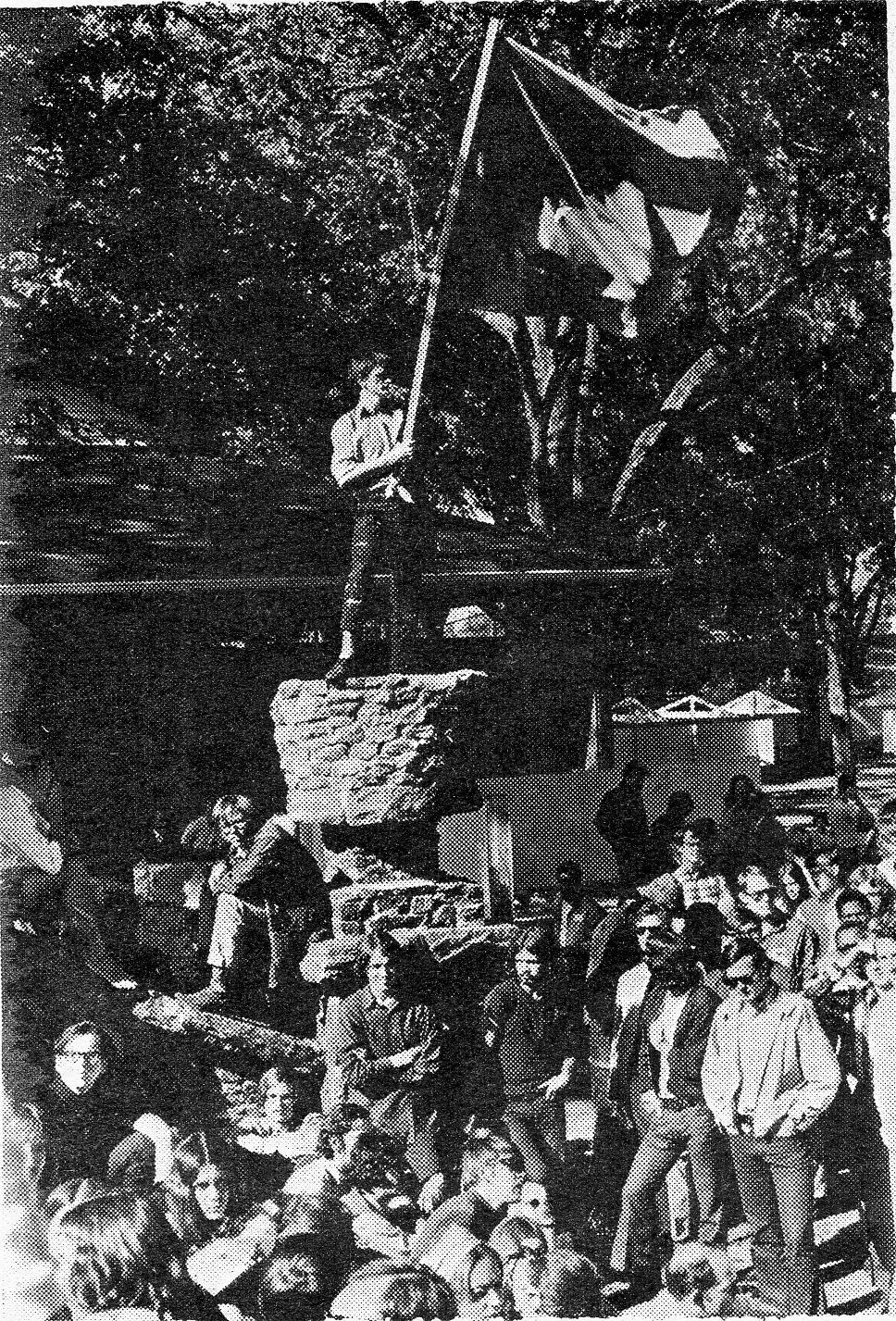
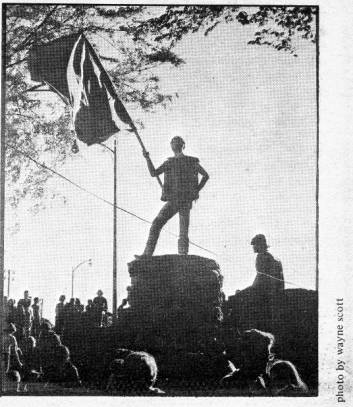
The only happening at the park Sunday which approached the power and the glory of the music was the waving red flag, another nonverbal experience which colored the events of the entire day and night.


 UPS:  The tribal altar of Piedmont Park-stone pillars on either side of a two-stage stairway, level after level of people, sitting on the grass, on the steps, on the pillars, with the band, behind, in front, on all sides, across the top outlined by sun and sky, milling around, surrounding and enveloping and being enveloped by the music in an unbroken web of tribal psyche, sun, trees, grass, grass, music, animals, man woman and child all vibrating as one out of tune with die seats of established power and in tune with other communities wherever our music is being played

 One together person reading Cummings’ “I sing of Olaf” to an overwhelmed audience unused to hearing those most militant statements—

“I will not kiss your fucking flag”

“There is some shit I will not eat”

 Black saxophonist coming out of the crowd to jam with the band

New tribesmen passing their own version of the peace pipe

Phil Weldon rapping gently but forcibly about the red flag blazing above the stone pillar

Angry interchanges between Barry Weinstock and members of the community at midnight Sunday when it became obvious to everyone that spending the night in the park would accomplish not one fucking thing for anyone except those who dig spending the night in the park with the blessing, approval and “permission” of their city “fathers”

 The power structure takes policemen out of our community and sends them into black neighborhoods to do their rotten thing and gives us our very own detective to soothe our ruffled white middle class beautiful gentle people (i.e. non- violent) feathers, and our self-appointed “leader” leads us to believe that we have won a great victory.

image024

DOWN OF THE DAY-Barry Weinstock asking the band to stop playing so he could go into his rap!


The most subversive manifestation of the power of our music is its ability to weld an entire park full of every type of person from all walks of life into one, throbbing pulsation of experience.

image026


Georgia State University’s Library has this issue of the Bird available as a pdf. here.